
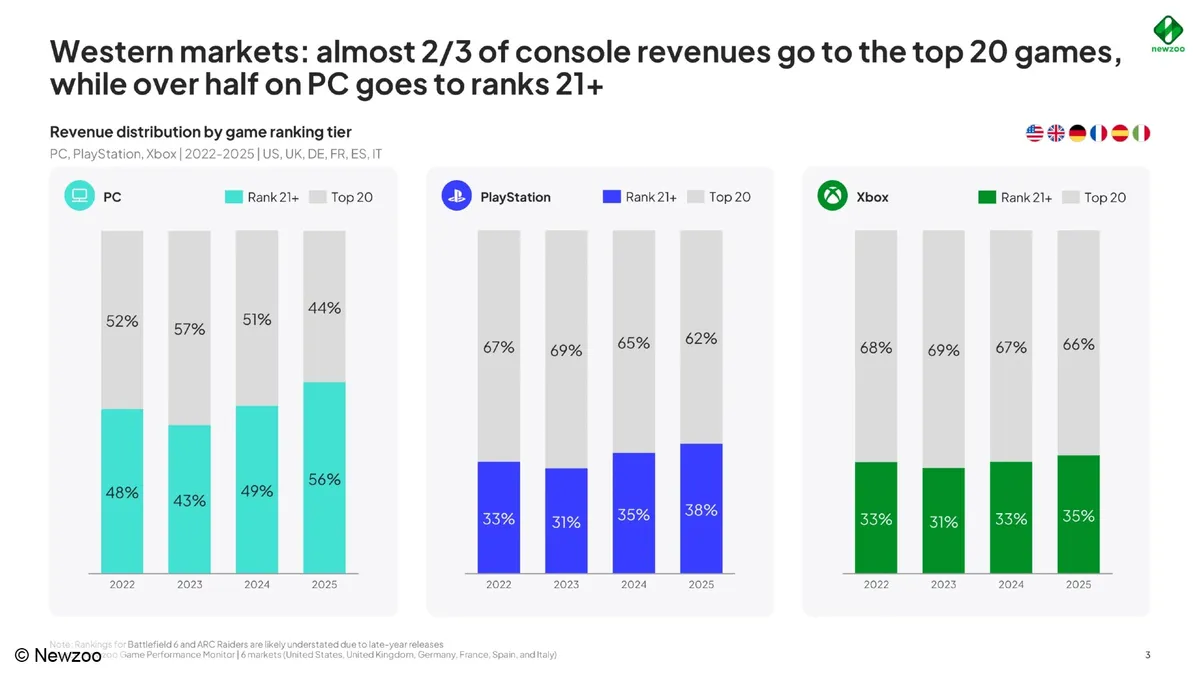
It's easy to assume the games dominating player counts are also dominating wallets, but new data challenges that assumption in a pretty significant way. According to a report covered by PCGamesN, titles outside the top 20 most-played PC games now account for over 50% of the sector's total revenue.
Games like Fortnite, Minecraft, and Dota 2 still pull enormous concurrent player numbers, and their cultural footprint is undeniable. But raw player counts and actual spending don't always move in the same direction, especially when free-to-play titles are part of the equation.

The long tail is doing serious work
The data points to a broader, more diverse ecosystem than the usual headline-grabbers suggest. Mid-tier titles, niche genres, and premium games with smaller but dedicated audiences are collectively generating revenue that outpaces gaming's most visible properties.
This shouldn't be entirely surprising given the sheer volume of games available on PC compared to consoles. Steam alone adds thousands of titles per year, and while most won't crack the top 100 in player numbers, even modest sales across a huge catalogue stack up fast.

What this means for the industry
For developers and publishers, this is actually encouraging news. It reinforces that you don't need to chase Fortnite's player numbers to build a financially viable PC game. Niche audiences tend to spend more per head, and PC players specifically have a long history of supporting games through DLC, expansions, and direct purchases rather than purely free-to-play monetisation.
It also complicates how the industry should be measuring health and success. Player metrics have always been the flashiest number to report, but revenue distribution data like this gives a much clearer picture of where the real economic activity is happening.
For players, this data quietly explains why so many genres that feel underserved on console continue to thrive on PC. Strategy games, simulation titles, and deep RPGs may never trend on social media, but they're clearly finding buyers in numbers that matter to the bottom line.
The full breakdown of the data is available via PCGamesN.